Sudden deaths can leave grieving families with big questions. But answers are often presented via a highly technical document for which they are not the intended audience. Sadly, autopsy reports can often raise more questions than they answer.
Now, what if family-friendly lay summaries could be created to translate the key findings into accessible language? And what if generative AI could be used to write them, removing the burden from pathologists?
Well – according to a team at Stanford School of Medicine, it can.
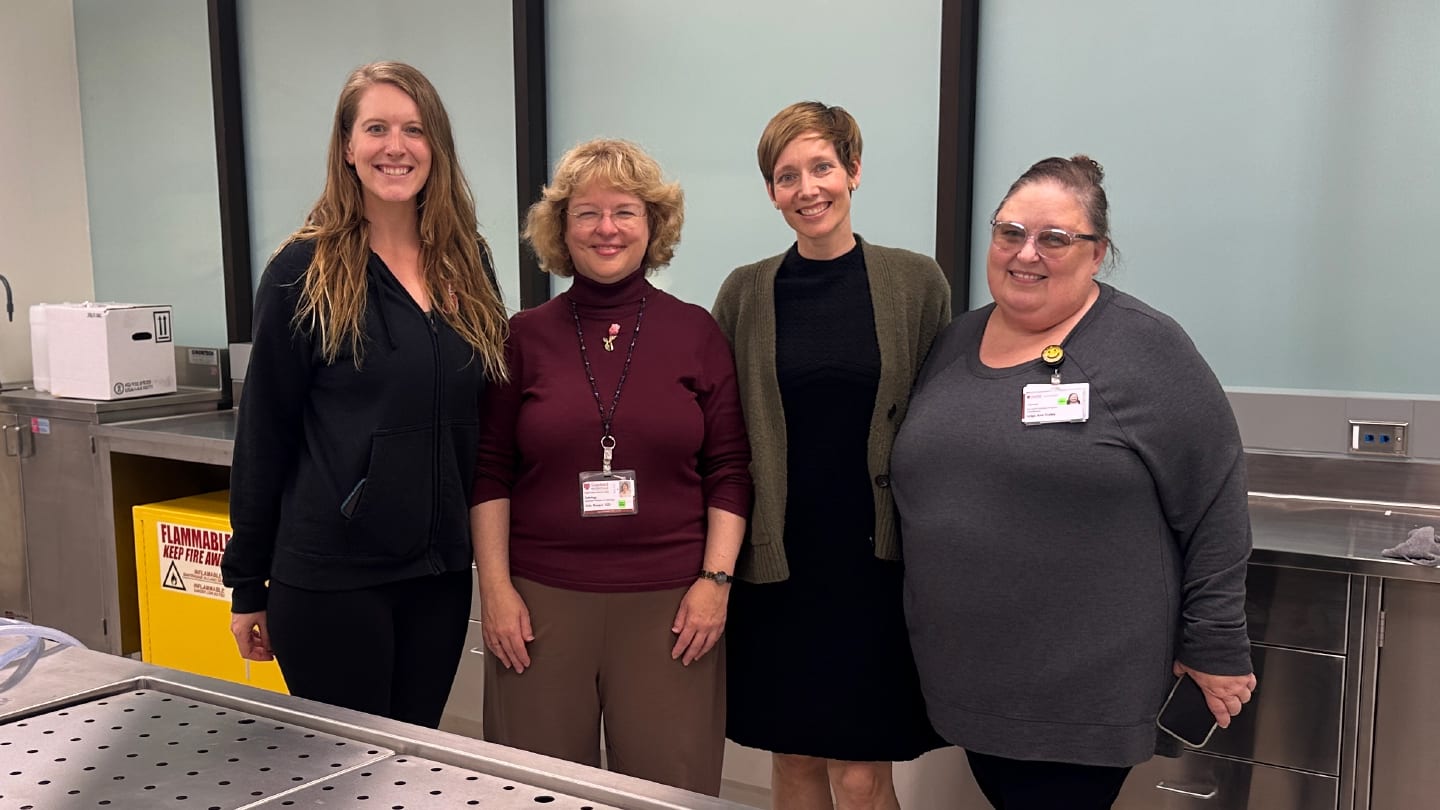
After presenting the work at USCAP 2026, Meagan Chambers, Assistant Professor of Pathology, gave us the lowdown.
What problems can arise from using traditional autopsy reports in communications with bereaved families?
The autopsy report is unique in pathology because the primary consumer is not a fellow clinician, but the patient – in this case, the next of kin. All too often, family members and next of kin receive a lengthy, highly technical autopsy report, with no support from an intermediary clinical provider to help them navigate it. While many institutions, including my own, offer follow-up conversations with family members, many turn to Dr Google first – often ending up with even more questions than before they saw the report.
As a precursor to our work in this area, we undertook a systematic review of family-centered best practices in autopsy. One of the most striking findings is how rarely the written report itself has been studied as a communication tool. Of 339 best-practice recommendations we extracted from 235 papers on family-centered autopsy care, only six addressed report writing. But if you ask any autopsy pathologist, they will acknowledge that the technical nature of the reports is problematic for families.
What solutions have been tried so far?
Within the papers that did identify report writing as problematic, no practical solutions were identified. A couple of papers suggested adjusting the reading level for better comprehension, or even making a summary. However, time limitations and the need for high level diagnostic standards in the report make this very challenging. To our knowledge, no one has yet found a practical solution that works within the time and resource constraints inherent in pathology.
Currently, the go-to solution is to offer family meetings. But this approach facilitates a cycle of confusion first, followed by resolution. So, for years we have been stuck at an impasse that prolongs distress.
What do guidelines recommend for these communications?
There is a rich body of guidance on patient-centered communication – it's just that none of it has been applied to autopsy reports. That's really the crux of the problem.
Autopsy reports are complex documents for legitimate reasons. CAP reporting standards set rigorous requirements for what a complete autopsy report must contain. Laboratory accreditation guidelines, medicolegal frameworks, and forensic evidentiary standards all shape the structure and language of these documents. And rightly so. An autopsy report is simultaneously a clinical record, a legal document, a quality assurance instrument, and in forensic cases, potential evidence.
The technical density of autopsy reports isn't an accident; it's a regulatory requirement. Any workable solution has to leave all of that intact. So the balance is delicate: how to maintain high diagnostic standards and leave a clear line of medical grade thinking for our peers, while also communicating with families.
How are you approaching the problem?
We're not proposing to rewrite autopsy reports – we're proposing to translate them.
That distinction matters, because once you frame it as translation rather than modification, you realize there's an entire field built to help you do it. The broader healthcare world has been working on plain-language patient communication for decades.
The CDC has explicit plain-language guidelines recommending that patient-facing health materials be written at a sixth to eighth grade reading level. That's the benchmark we use when evaluating our AI-generated summaries, using Flesch-Kincaid Grade Level and Flesch Reading Ease scores. We used a number of these guidelines, as well as work in other parts of anatomic and clinical pathology, to inform our solution.
How can AI help to translate autopsy reports for families?
Our solution takes the autopsy report as it is, and uses a large language model (LLM) to create a summary in a structured format that uses everyday language. The LLM is Health Insurance Portability and Accountability Act (HIPPA) compliant and institutionally approved.
Because the pathologist has already identified and described the findings, the LLM doesn’t need to make anything up; it just needs to summarize what is already there. This is key to why this has worked so well for us, and made it relatively easy to apply at our institution.
Why use AI in preference to humans for this task?
The discussion around AI-assisted healthcare has always emphasized the potential time savings and efficiencies which technology can allow, freeing pathologists to attend to things technology can’t do.
It is absolutely possible for the autopsyist to write a family friendly summary of their report. The main barrier has always been time. Most institutional LLM models already in place can generate a first-pass plain-language summary instantly, from the completed report, at the moment the pathologist would otherwise move on to the next case. It doesn't replace the human — a pathologist still reviews and signs off — but it eliminates the blank-page problem and the time burden.
Critically, the LLM can apply a structured framework consistently, ensuring that the summary addresses the questions families typically want answered: what caused the death, were there unexpected findings, are there any implications for living family members, and what happens next.
Tell us about the AI system your group developed, and how it helps to address communication issues.
The best part about this project is that it didn’t require that we train a proprietary LLM model to do this work. It uses our institutional HIPPA-compliant LLM that is available to all providers at our hospital. Many hospitals across the country have some similar resource already in place and so there is a limited barrier for others to adopt this at their own institution.
In brief, we developed a prompt – which is available here – based on guidelines identified by our background systematic review and other guidelines from patient centered reporting. We copy–paste the entire autopsy report into the HIPPA-compliant LLM, along with the prompt, and out pops a one- or two-page plain English, or “family-friendly”, summary of the findings a few seconds later.
The report is structured according to the framework I mentioned. We also include a glossary of the more common medical terms used in the report.
Could you elaborate on the development process?
This has been a genuinely collaborative project. It grew out of the interests of a summer intern regarding the patient experience – in this case, the next of kin. The systematic review came first, because I didn't want to build a tool based on intuition about what families need. I wanted it grounded in data.
The AI development emerged from that foundation. The development process itself involved pathology trainees, faculty colleagues, and input from our autopsy service. One of the important things we did early was define what "good" actually looks like. That sounds obvious, but it's not trivial. A family-friendly summary could be condescending and incomplete, or technically accurate but emotionally devastating in the way it's phrased.
What challenges arose?
The biggest challenges were, honestly, around the framework more than the AI. We already knew the LLM was capable. The hard work was deciding what the prompt should require, what it should prohibit, and how to handle edge cases – deaths where the cause is genuinely uncertain or required exceptionally complex antemortem care. Each of those requires specific guidance in the framework that we worked through iteratively.
How accurate is the AI tool? Do the reports need many human corrections?
In practice, we would always recommend reading the output before its shared, but to date, the LLMs we have tried have done a great job. The outputs contained no overt errors and required very little editing.
How will you assess the impact of the family-friendly summaries?
We are preparing an independent review board approved survey, for both families and non-pathology clinicians, to get their impressions of this new part of the report. Our hope is that both parties will feel that there is value in having this clarifying information front and center for the next of kin.
What's next for this project?
Longer term, I'd love to see this become a standard part of how autopsy reports are generated – not as an afterthought but built into the workflow from the start. At Stanford, if the data from providers and next of kin comes back positive, we plan to build a separate section for this into the report to make it even easier for next of kin to find.
What other work has your group been doing on family-centered practices in autopsy?
The systematic review is really the foundation of everything else. It's the first comprehensive synthesis of the evidence base for family-centered autopsy practice across the full workflow – consent, the examination itself, report writing, and post-report communication – and the findings are genuinely striking. The literature is dominated by the consent conversation; the actual examination and the written report are barely studied at all. We're preparing that for publication, and I think it'll be useful for the field to have that map.
We've also been doing workflow characterization at our institution – looking at how the autopsy process functions from the family's perspective, where the gaps are, and what structural changes would be most impactful. That's the kind of ground-level observation that I think is often missing in contemporary academic discussions of autopsy best practices.
And there's a broader committee-level effort through the CAP Autopsy Committee to bring these ideas into the conversation at the specialty level. That's a longer game, but I think it's important. Individual institutions can innovate, but practice change at scale requires the professional societies to be engaged. That's part of what we're trying to do.
Ultimately, I think the value of this particular project is that it uses existing technology to make things better for our patients. I hope that readers will use the attached guide to explore this more at their own institution and be in touch with us to share their challenges and successes.
Newsletters
Receive the latest pathologist news, personalities, education, and career development – weekly to your inbox.
