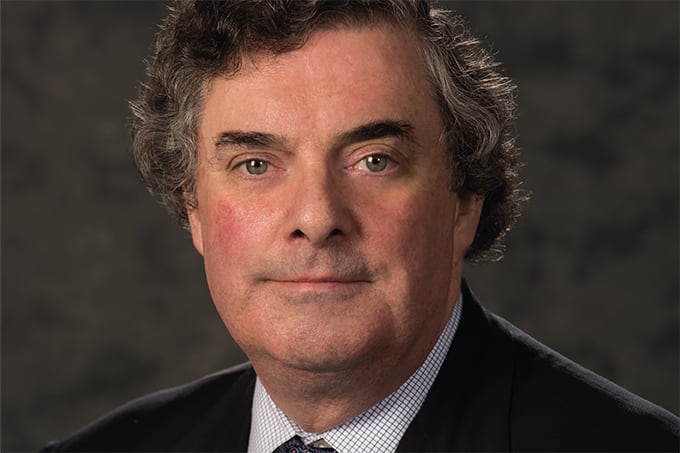
Christopher Fletcher (1958–2024)
Professor of Pathology at Harvard Medical School, Senior Pathologist and Vice Chair of Anatomic Pathology at Brigham and Women’s Hospital, and Chief of Onco-Pathology at the Dana-Farber Cancer Institute
False
Professor of Pathology at Harvard Medical School, Senior Pathologist and Vice Chair of Anatomic Pathology at Brigham and Women’s Hospital, and Chief of Onco-Pathology at the Dana-Farber Cancer Institute
What they said about Christopher Fletcher
“Chris is a man of many motivations – the challenge of rendering accurate and clinically useful diagnoses, the wish to guide patient care and share knowledge, the excitement of continual discovery and the pleasure of interacting with trainees.”
“Some losses are irreparable. Rest in peace. The biggest contributor in the field of tumor pathology.”
Quotes from Christopher Fletcher
On what energized him for his many conflicting duties:
“It’s nice to feel that I’m doing something useful. I enjoy helping young pathologists get into their careers. I never thought I would end up managing so many people, but it turns out that I quite like it. It does become somewhat tiring; here in anatomic pathology at the Brigham, we have around 70 faculty and 50 trainees! With so many people, you have to keep an eye on things like workload, logistics, interpersonal issues, trouble at home… In the end, people are important. If you don’t care about people, they will not do well.”
On how he came to edit The Diagnostic Histopathology of Tumors:
“Everything in life is an accident – at least, I haven’t planned anything in my life. In the early 1990s, Nicholas Wright, Chairman of Pathology at the Royal Postgraduate Medical School in London, suggested to Churchill Livingstone the idea of publishing a new book focused only on diagnostic pathology of tumors. They contacted me and I, in turn, selected the contributors for each individual chapter. (I did, and still always do, edit every chapter to make sure they don’t feel dramatically different from one another.) My involvement in the book came about by serendipity, but it’s hard work that keeps it up-to-date and in print.”
On discovering new entities in soft tissue pathology:
“I am constantly amazed that we still see and describe previously unrecognized entities even now. We are currently working on a couple for which I started collecting the cases in the early 1990s, nearly 30 years ago. When I think something is going to be a novel disease entity, I try to use certain keywords to make it easier to retrieve the cases from our files. I find it astonishing that, for example, if we pull 50 cases of something that has never been described but is in my head, 45 of them usually look pretty much identical. Fortunately, the keywords make it easy to collate and describe them.”

Year 2015
Who are the most influential laboratory medicine professionals? That’s the question we posed to ourselves – and then to you – over two months ago, ahead of open nominations and a painstaking judging process. Here, without further ado, we celebrate the answer.

Year 2019
We honor 100 of the leading innovators in pathology and laboratory medicine by celebrating their success at the cutting edge of the field.
Dive deeper into the world of pathology. Explore the latest articles, case studies, expert insights, and groundbreaking research.
Receive the latest pathologist news, personalities, education, and career development – weekly to your inbox.
False