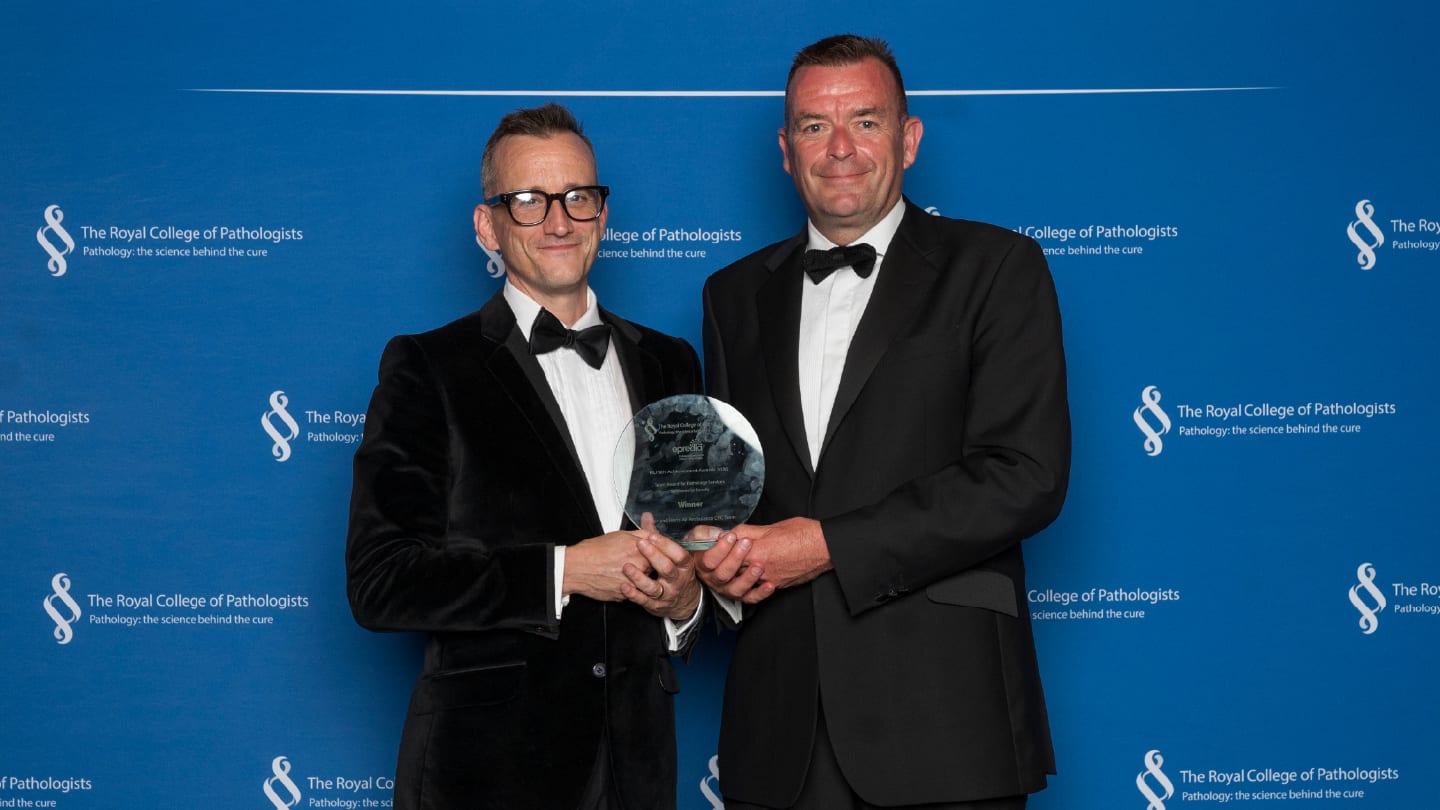
Since the Essex & Herts Air Ambulance Trust (EHAAT) found a way to integrate forensic pathology expertise into its clinical governance pathway, the resulting learnings have benefitted not only patient care, but also family support and even clinician well-being. The impact of this work was recently recognized by the Royal College of Pathologists, which awarded EHAAT a team prize for pathology services.
The Pathologist met with two key instigators of the partnership, Ben Swift, a Home Office Registered Forensic Pathologist, and Gareth Grier, Associate Medical Director of EHAAT. Here, they explain how the partnership works and what it means to both the air ambulance team and the patients it serves.
What first prompted the partnership?
Gareth Grier: As an air ambulance service, we send senior doctors and experienced paramedics to patients who are critically ill or seriously injured. By definition, we're seeing patients at the most severe end of the spectrum.
We found that when we reviewed cases – to examine circumstances at the scene, the decisions made, and the interventions performed – there was a persistent gap. If a patient died at the scene, or very early after arriving in hospital, it was remarkably difficult to obtain the autopsy findings or even a definitive cause of death.
That's particularly important in prehospital medicine because we don't have the benefit of CT or MRI scans. You're relying on clinical judgement in an environment that's fast-moving, challenging, and often chaotic. You make the best decisions you can with limited information, but thereafter, it's difficult to know whether your diagnosis was correct.
The project really began when we employed a clinical fellow, Michael Kim, who introduced me to Ben. We had some conversations about how he could help and, since then, Ben's generously given his own time to help us bridge that gap between what we think happened clinically and what the autopsy ultimately revealed.
Why has it traditionally been so difficult for prehospital teams to access autopsy findings?
Ben Swift: In England and Wales, the coronial system operates entirely separately from healthcare provision. The two systems rarely communicate directly; in practice, they tend to interact through legal processes rather than clinical ones. As a result, sharing information is often difficult.
For the air ambulance teams, this meant it was almost impossible to speak to the pathologist who had carried out the post-mortem examination on one of their cases. There was no established mechanism for discussing individual cases or feeding the findings back to the clinicians involved.
How did you manage to beat the system, and bring autopsy findings into EHAAT?
BS: When Michael Kim approached me to ask whether he could observe the post-mortem examination of a patient he had attended, with the coroner's permission, I was very happy to help. We went through the findings together, discussed what they meant clinically, and, importantly, I was able to reassure him that the team had recognized the correct pathology and done everything they could for the patient.
We quickly realized this could be more than a one-off conversation. It presented an opportunity to establish a regular process whereby, working closely with coroners and fellow forensic pathologists, we could share the outcomes of post-mortem examinations from cases attended by the air ambulance service.
From the outset, we've worked closely with the senior coroners in Essex and Hertfordshire. They've attended our meetings themselves and have seen first-hand the educational value of bringing clinicians and pathologists together. Once they understood the purpose – that we weren't revisiting cases to assign blame, but to improve learning and ultimately patient care – they were very supportive.
What kind of learning culture is needed for this type of collaboration to succeed?
GG: In healthcare, reviews are typically triggered only after something is perceived to have gone wrong – particularly when a patient has died. As a result, meetings labelled as incident reviews or after-action reviews can carry an implicit assumption of blame.
We wanted to move away from that. Our aim was to make case reviews routine, so that every case becomes an opportunity for learning rather than an investigation into failure. When clinicians know they're entering a supportive learning environment, they're much more willing to engage openly and honestly in discussions about their decision-making.
One advantage of working within the UK's charity-funded air ambulance sector is that we're able to dedicate time and resources to this process. At EHAAT, every Tuesday is set aside for governance and case review. Except for those on active duty, clinicians are freed from operational duties so they can spend the day reviewing cases together, without any assumption that an error has occurred. That creates an environment that's genuinely conducive to learning.
How do autopsy findings become part of the air ambulance team's learning process?
GG: Sometimes the cause of death is multifactorial. While a patient may have sustained multiple injuries, only one or two are actually driving their physiological deterioration at any given moment. Those are the problems we need to identify and prioritize during prehospital care.
Head injury is a good example. Two patients may present in a very similar way, but the underlying pathology can be completely different. One might have a large intracranial hematoma requiring immediate transfer to a neurosurgical center for emergency surgery. Another may have relatively little intracranial bleeding but suffering hypoxic brain injury caused by inadequate oxygenation, and optimizing ventilation may be the priority.
Either of those patients might also have significant bleeding from the liver or spleen, and our challenge at the scene is to determine which injuries are contributing most to their condition and to treat them in the right order, within a very limited timeframe.
This is where the autopsy findings become so valuable. They allow us to revisit our clinical reasoning and ask whether we correctly identified the injuries that mattered most, whether we prioritized them appropriately, and whether there was anything we could have done differently.
How has access to autopsy findings changed conversations with bereaved families?
GG: Bereaved families naturally ask difficult but deeply important questions: Did the team do everything they could? Was there anything else that might have been done? Was my loved one ever going to survive?
We have a Patient and Family Liaison Team made up of specialist nurses who support families after someone has died. In the past, they often had very little information about the injuries that had caused a person's death, making it incredibly hard to fully answer questions from families. Now, having access to the post-mortem findings equips our liaison nurses to provide families with much clearer explanations of what happened, rather than leaving them with unanswered questions.
There's another important dimension to this as well, which is the psychological impact on clinicians. I think it's fair to say that many of us can recall cases that have stayed with us for years because we never had any real sense of closure. Without knowing exactly what happened, that lingering uncertainty can be difficult to shake. Having the autopsy findings helps answer some of those questions for the clinicians who treated the patient.
How else has the service improved as a result of this partnership?
GG: We've recently launched a project at EHAAT using live video technology in the ambulance control room. Much as emergency call handlers coach members of the public through CPR during a cardiac arrest, our senior paramedics can now guide callers through simple airway maneuvers for someone with a severe head injury. The hope is that, even before the air ambulance arrives, those patients will have better oxygen levels and a better chance of avoiding secondary brain injury. That's a direct example of how understanding the true causes of death helps us innovate in ways that are targeted and meaningful.
The same principle applies to education. We place a great deal of emphasis on simulation training, but we've increasingly moved towards what we call "pathology-first simulation." Every scenario begins with a clearly defined underlying pathology, informed by what we've learned through the case reviews with Ben.
The research benefits are just as important. By incorporating post-mortem findings into our research program, we can define patient groups much more accurately. Instead of treating all head injuries as though they're the same, we can distinguish between the different pathological processes involved and ask much more focused research questions. Ultimately, that's what will lead to better treatments and better outcomes.
As medical science continues to advance, EHAAT recognized that maintaining excellence in pre-hospital emergency medicine would require an equally forward-thinking approach. That’s why, in 2022, we launched our Centre for Excellence. It’s our long-term commitment to driving innovation, advancing clinical knowledge, and preparing our teams for the challenges of the future.
What impact has the collaboration had beyond your own organizations?
BS: I've been invited to speak at air ambulance conferences to explain what forensic pathologists do, how we work within the coronial system, and how we can contribute to clinical learning. Those conversations have prompted other air ambulance services to develop similar partnerships. I've often been able to introduce them to their local forensic pathologist.
It's been really encouraging to see other services adapt what we've been doing. The principles are transferable, and colleagues have been able to establish similar collaborations with their own local forensic teams. That means more clinicians are benefiting from structured feedback following post-mortem examinations, and more pathologists are becoming involved in multidisciplinary learning.
The exchange has worked both ways. At the recent British Association in Forensic Medicine meeting, for example, we invited an air ambulance doctor to explain how prehospital teams assess and manage critically injured patients. Bringing the two specialties together has strengthened both sides of the conversation.
Do you see this model being applied beyond individual case reviews?
GG: We're also exploring how these principles could be applied to major incidents involving multiple casualties. Following events such as the 2016 Pulse Nightclub shooting in Florida, there have been important efforts to examine the pathology of victims alongside the emergency response to understand whether interventions were delivered in the most timely and effective way, and what lessons could be learned for future incidents.
We're interested in bringing that same approach into our own work. The aim is to make this kind of multidisciplinary review a routine part of learning after major incidents, so that pathology findings can be considered alongside the operational response from the emergency services.
What would you like other services and pathologists to take away from this work?
BS: Earlier this year, we published a paper describing the value of multidisciplinary case review meetings that involve forensic pathologists. Hopefully, that will help spread the message among the wider prehospital and emergency medicine community, and encourage other services to consider a similar approach.
I'm also keen to publish guidance aimed specifically at the pathology community. The goal is to give forensic pathologists practical advice on how to establish these collaborations, build relationships with local air ambulance services, and create a framework for regular case discussions.
One of the most important messages I'd like colleagues to take away is that this isn't simply about pathologists providing information to clinicians. We gain just as much from the process ourselves. Understanding the clinical decision-making, the physiology unfolding at the scene, and the challenges faced by prehospital teams gives us a much richer perspective on the cases we investigate.
It's very much a two-way street.
Newsletters
Receive the latest pathologist news, personalities, education, and career development – weekly to your inbox.