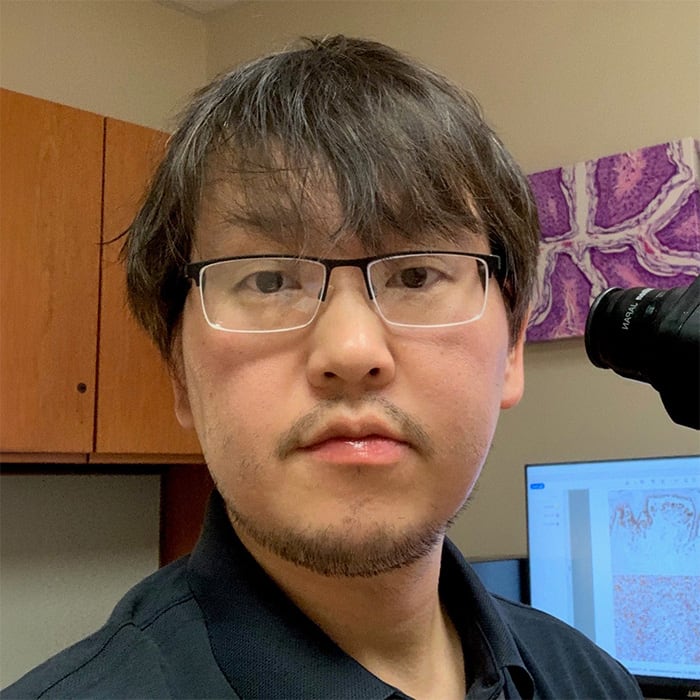
Woo Cheal Cho
Assistant Professor, Section of Dermatopathology, Department of Anatomical Pathology, University of Texas MD Anderson Cancer Center, USA.
False
Assistant Professor, Section of Dermatopathology, Department of Anatomical Pathology, University of Texas MD Anderson Cancer Center, USA.
What gaps in technology/training/processes concern you most, and how are you addressing them via innovation?
One of the biggest concerns I have about the future of pathology is that technology is advancing faster than our ability to integrate it thoughtfully into diagnostic practice and training. Digital pathology, artificial intelligence (AI), molecular testing, and other computational tools are transforming the field, but technology is only as valuable as the way we use it. The challenge is ensuring that innovation enhances diagnostic accuracy rather than inadvertently replacing the critical thinking and meticulous morphologic examination that remain fundamental to pathology.
I am particularly concerned about the gradual erosion of what I would call the “analog” aspects of pathology – the ability to recognize normal histology, appreciate subtle morphologic changes, and understand the architecture and cellular composition of tissues before reaching for increasingly sophisticated ancillary tests. Histopathology remains the foundation of our specialty. Before considering immunohistochemistry and sophisticated molecular studies, a pathologist must first understand what normal looks like across organ systems and recognize when something is truly abnormal.
This may sound fundamental, but I believe it is an increasingly important gap in both training and practice. In an era when we can obtain enormous amounts of molecular information from a small tissue sample, there is a risk that we become more comfortable generating additional data than carefully interpreting the morphology in front of us. Yet some consequential diagnostic errors can arise from subtle morphologic misinterpretations that no amount of sophisticated testing can compensate for.
For example, in cutaneous squamous cell carcinoma, normal arrector pili muscle can sometimes be mistaken for a nerve bundle, leading to an erroneous diagnosis of perineural invasion. Such a diagnosis can influence staging and, in some circumstances, lead to radiation therapy. Recognizing normal structures of the skin is therefore not simply an academic exercise; it can directly affect patient care.
I try to address this gap by encouraging trainees to master normal histology across organ systems and develop a strong mental library of normal structures before attempting to render sophisticated diagnoses. Before asking what a lesion is, they should ask: What am I actually looking at? What structures should normally be present here? Is the morphology truly abnormal, or am I simply unfamiliar with a normal tissue component?
Ultimately, I do not see innovation and traditional histopathology as competing philosophies. I see them as complementary. The pathologist of the future will need to understand AI, digital pathology, molecular diagnostics, and increasingly complex datasets, but those tools will be most powerful in the hands of someone with a strong foundation in morphology.
The goal of innovation should not be to make the microscope less important. It should be to make the pathologist better at using everything available – from a glass slide to next-generation sequencing to an AI algorithm – to arrive at the most accurate diagnosis possible. In an increasingly digital specialty, one principle remains timeless: know what normal looks like, recognize what is truly abnormal, and understand the morphology before you reach for the next test. That “analog” foundation remains essential for accurate diagnosis and, ultimately, optimal patient care.
Dive deeper into the world of pathology. Explore the latest articles, case studies, expert insights, and groundbreaking research.
Receive the latest pathologist news, personalities, education, and career development – weekly to your inbox.
False