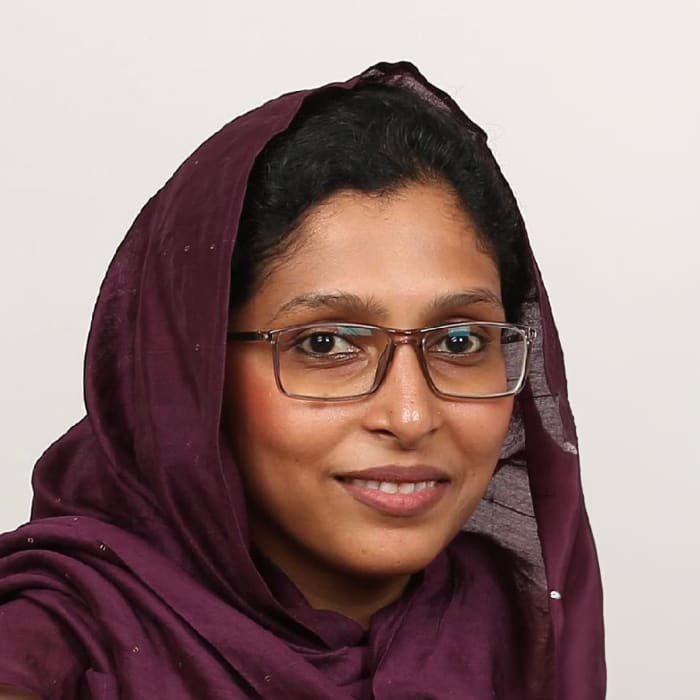
Seyed Rabia
Senior Consultant Pathologist and Head of the Department of Pathology; Kanchi Kamakoti CHILDS Trust Hospital, Chennai, India.
False
Senior Consultant Pathologist and Head of the Department of Pathology; Kanchi Kamakoti CHILDS Trust Hospital, Chennai, India.
What’s the biggest challenge facing your specialty right now, and how are you addressing it via leadership?
Pathology is at the precipice of evolving into an automated, objective field that delivers results with pinpoint precision. As the sustainability of a trained workforce is increasingly difficult and in this fast-paced insta-everything, litigious world, the shift is welcome and makes work easier overall.
However, this current milieu has tamped down the fact that the pathologist is still a physician. Working in diagnostics should start with fine-tuning instruments capable of fulfilling ever-tightening CV criteria, managing the workforce and translating all of this into patient care.
My position as the Head of the Department of Pathology in a tertiary care pediatric center in South India presents me with unique challenges daily. We cater typically to a resource-limited population; what this entails is that on minimal expenditure and the shortest possible turnaround time, we strive to provide results on par with international standards.
While embracing, mastering, and streamlining automation, there is a "quis custodiet ipsos custodes?" angle to tackle.
The biggest challenge a hospital-based laboratory faces is to mitigate and escalate cases when there is a barrage of them. Our machines have been calibrated, the QCs have passed, and the EQA programs are satisfactory.
And yet, it behooves us to listen to the patient and the treating physician. What seems like a normal CBC still warrants a peripheral smear if there is joint pain keeping the child up at night (interestingly, a chunk of acute leukemia cases has come in from Orthopedics!) Are there Heinz bodies in the smear before treatment for tumor lysis is started? Is the platelet count on the smear really what the machine flagged, before they transfuse?
To tackle this challenge, we have developed training programs that we adhere to with military precision. This has helped the technicians pick up blasts, parasites and schistocytes in the night. Time-consuming manual tests like Sickling, Kleihauer-Betke, Mixing studies in coagulation, Nitroblue Tetrazolium Tests still hold screening and diagnostic value, so we have continued training technicians in them. A set protocol for extracting the relevant history from residents/physicians and easy access to patient records (which are dutifully provided by the clinicians/surgeons) has greatly helped in reporting.
In with the new, but not entirely out with the old.
A pathologist should be a part of tumor boards, transfusion committees, resident-teaching and other decision-making entities. At their core, they are a physician, a pedagogist, administrator, and laboratory scientist. Young pathologists should speak their piece, pull up a chair to the table, and pick up the phone calls.
The ultimate challenge over the last decade has been to embody "kaizen" as a laboratory professional and be a “doctor’s doctor”, despite all variables.
Dive deeper into the world of pathology. Explore the latest articles, case studies, expert insights, and groundbreaking research.
Receive the latest pathologist news, personalities, education, and career development – weekly to your inbox.
False