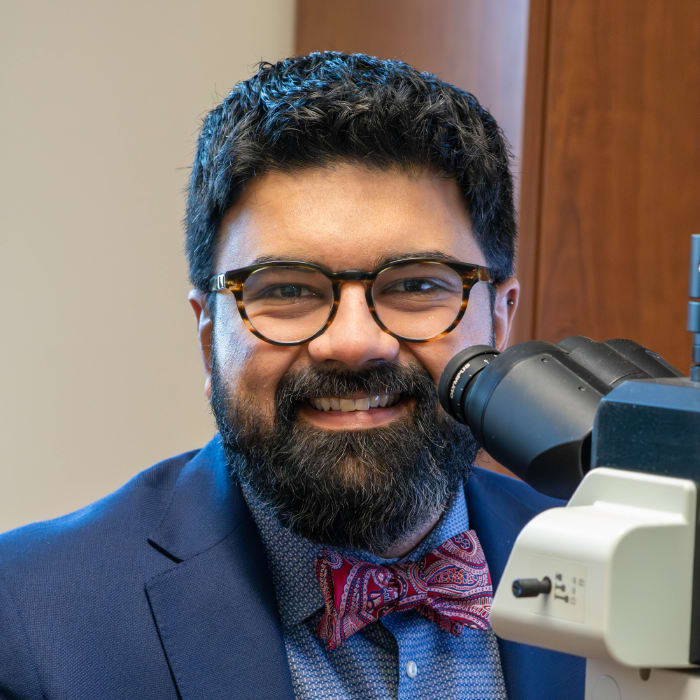
Kamran Mirza
Professor of Pathology, Michigan Medicine, Ann Arbor, Michigan, USA.
False
Professor of Pathology, Michigan Medicine, Ann Arbor, Michigan, USA.
What’s the biggest challenge facing your specialty right now, and how are you addressing it via leadership?
This year, I co-wrote a children's book in which a boy named Leo, newly diagnosed with leukemia, asks who looks at his blood, and a tiny explorer named Mia shrinks down to show him. Most adults cannot answer Leo's question either. Ask a patient who diagnosed her cancer and she will name her surgeon, her oncologist, sometimes her radiologist, but almost never the pathologist who read the slide and wrote the words that set everything else in motion.
The biggest challenge facing pathology is not artificial intelligence or workforce projections or reimbursement, though we spend most of our meetings on all three. It is invisibility. We have built a specialty that medicine cannot function without and the public cannot see, and invisibility compounds quietly over the years, because specialties nobody sees struggle to recruit, lose the policy arguments that shape their practice, and eventually find other people narrating their future for them.
I have spent my career treating visibility as a leadership problem rather than a marketing one. PathElective began as a free, open pathology curriculum and grew into a global community of learners, many of whom had never met a pathologist before they met one online. In our department, where I co-chair the Patient and Family Advisory Council, we have established pathology clinics where patients can sit with the pathologist who interpreted their biopsy and view their own cells.. Anyone who has watched a patient study their lymphoma through the microscope, asked questions, and walked out finally understanding their own diagnosis stops believing that pathology's distance from patients is natural; it is only habitual.
The same conviction carries across oceans. Through the Global Pathology and Laboratory Medicine Consortium, we work with colleagues in Kenya and across Africa to build local diagnostic capacity rather than export expertise, because a diagnosis that cannot be made at all is the most invisible diagnosis of all.
A children's book, a free curriculum, a patient council, and a global consortium may look like scattered work, but they are one project, and every one of them answers Leo's question.
The microscope taught us to see what others could not. The coming era asks something harder: that we make ourselves visible. Our diagnoses have never been better, but our future may depend on whether others understand who makes them.
Dive deeper into the world of pathology. Explore the latest articles, case studies, expert insights, and groundbreaking research.
Receive the latest pathologist news, personalities, education, and career development – weekly to your inbox.
False