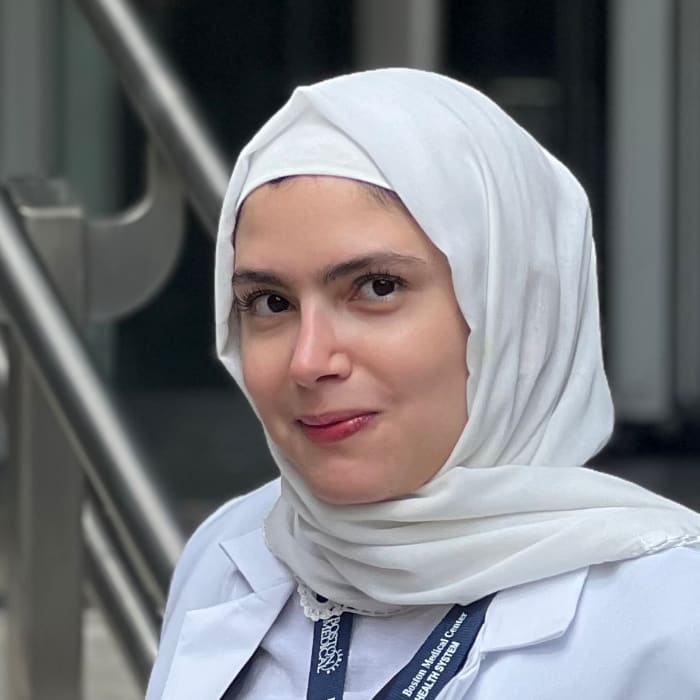
AlBatool AlMahdy Abdelghaffar
Dermatopathology Fellow, Boston University, USA
False
Dermatopathology Fellow, Boston University, USA
What does the future of laboratory medicine look like, and how are you helping to future-proof your department?
Before I learned to navigate a digital slide, I trusted the quiet ritual of the microscope: placing a glass slide on the stage, adjusting the focus, and allowing a diagnosis to come into view. Today, in a fully digital fellowship, I have come to see that the future of laboratory medicine is not the loss of that discipline, but its expansion.
My training has spanned two distinct eras of pathology: a glass-slide-only residency at UMass-Baystate and a fully digital dermatopathology fellowship at Boston University. Seeing both has taught me that the strongest future is not a choice between traditional microscopy and digital pathology, but the ability to honor foundational skills while embracing new ways of learning, collaborating, and caring for patients.
I encourage residents, laboratory professionals, and learners to become comfortable with both glass and digital pathology. Digital pathology creates opportunities for education, consultation, accessibility, and collaboration across distance. As digital workflows become more established, artificial intelligence will increasingly support pathologists through efficiency, pattern recognition, and quality assurance. Yet human judgment, clinical context, and accountability will remain irreplaceable. Confidence is built when we greet the unfamiliar with curiosity, remain humble enough to learn, and let new tools sharpen not only our practice, but our care for the people behind every diagnosis.
To future-proof a department, we must also invest in people. Pathology is a field of lifelong learning and teaching. In academic settings, we teach residents, fellows, and students; in community practice, we continue teaching and learning from colleagues. No matter how experienced a pathologist may be, there will always be a difficult case that benefits from another expert’s perspective. Asking for help is not a sign of uncertainty; it reflects humility, collegiality, and a commitment to getting the diagnosis right for the patient.
Future-proofing also requires a workforce in which people from every background can see a place for themselves. As a woman and international medical graduate, I value mentorship that helps trainees feel seen, supported, and confident that their perspectives belong in pathology. I hope to advocate for women, international medical graduates, and learners from backgrounds underrepresented in medicine. Representation strengthens not only our profession, but also our ability to serve diverse patients and communities with empathy and understanding.
Communication is equally essential. Pathologists read the language of cells and translate it into clinically meaningful guidance. My experience as a chief resident, balancing leadership, teaching, tumor boards, and board preparation taught me that clarity and composure are cultivated through practice, mentorship, and community.
Finally, the future of laboratory medicine will not be written solely by the technologies we adopt, but by the curiosity with which we learn, the humility with which we consult, and the generosity with which we prepare those who will follow us. The present is a place of both promise and remembrance: we turn toward the future with hope, curiosity, and readiness to learn, while carrying the past with gratitude: its mentors, its lessons, and its enduring legacy, close to our hearts.
Dive deeper into the world of pathology. Explore the latest articles, case studies, expert insights, and groundbreaking research.
Receive the latest pathologist news, personalities, education, and career development – weekly to your inbox.
False