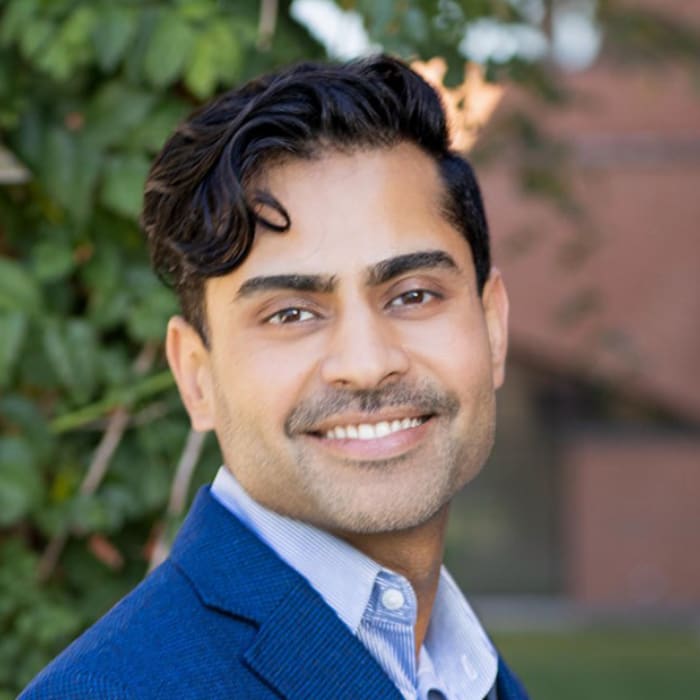
Aadil Ahmed
Division Chief and Fellowship Director, Dermatopathology, Loyola Stritch School of Medicine and Director of Dermatopathology, Illinois Dermatology Institute, Chicago, Illinois, USA
False
Division Chief and Fellowship Director, Dermatopathology, Loyola Stritch School of Medicine and Director of Dermatopathology, Illinois Dermatology Institute, Chicago, Illinois, USA
What’s the biggest challenge facing your specialty right now, and how are you addressing it via leadership?
The biggest challenge facing pathology today is not a shortage of diagnostic excellence, but that our full contribution is often reduced to a single output: the final diagnosis. Last year, I argued that pathologists should move beyond diagnosis to become clinical consultants. This year, my leadership goal has evolved further: Pathologists must lead the entire diagnostic pathway, make quality measurable, and translate that value into language clinicians, administrators, and patients understand.
A diagnosis does not begin at the microscope, and it does not end when the report is signed. It begins with clinical differential, the correct site, adequate sampling, and complete clinical information. It continues through interpretation, clear reporting, direct communication, and an understanding of treatment implications. Every stage is an opportunity to improve care and introduce avoidable error, delay, and medicolegal risk. This is the same logic behind laboratory accreditation checklists; pre-analytic, analytic, and post-analytic quality are inseparable. No stage can compensate for failure in another and a technically flawless interpretation of a poorly cited or mishandled specimen still fails the patient. The pathologist owns the entire pathway, but ownership only works when it is shared deliberately with clinicians, laboratory colleagues, and other specialists at the table, and not delegated silently and rediscovered only when something goes wrong.
Being technically excellent is not enough if that excellence isn't converted into visible, measurable outcomes. In my program, I teach residents and fellows that pattern recognition is the floor, not the ceiling. I teach them to structure reports so the actionable conclusion is immediately visible, to distinguish description from decision-relevant comment, and to recognize when a phone call matters more than another paragraph. Consultative practice must be treated as a professional competency to be taught and assessed – not a trait some pathologists happen to have.
This end-to-end model only becomes credible when its impact can be shown, not just claimed. Fewer repeat specimens, report amendments, and clarification calls from clinicians. Faster turnaround, better trainee report-writing evaluations, and more multidisciplinary case discussion. These are the metrics that let pathology's value travel outside pathology into tumor boards, department meetings, and the minds of the medical students who rotate through our service. When students see us integrate morphology, clinical reasoning, communication, and treatment implications into one continuous act, their assumption that pathology is a background specialty starts to dissolve. That shift matters for a pipeline problem the field cannot afford to ignore.
Pathology's future depends on training pathologists who can diagnose accurately, own the full clinical pathway, collaborate visibly across specialties, and communicate their value in terms the rest of medicine already speaks. That is the kind of leadership I am trying to build each day; one report, one trainee, one measurable outcome at a time.
Dive deeper into the world of pathology. Explore the latest articles, case studies, expert insights, and groundbreaking research.
Receive the latest pathologist news, personalities, education, and career development – weekly to your inbox.
False